
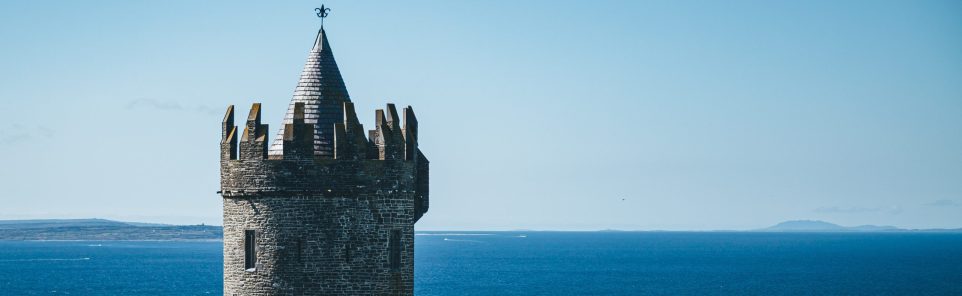
Doonagore Castle – A Picturesque Tower House In Ireland
Doonagore Castle is a picturesque fortification, more specifically a tower house, dating back to the 16th century and situated in the proximity of the coastal village of Doolin in County Clare, on Ireland’s charming west coast. This beautiful tower house is surrounded by a relatively small wall enclosure as well. The name of this historical landmark might be derived from Dún na Gabhair which could mean either ‘the fort of the rounded hills’ or ‘the fort of the goats’. Currently, Doonagore Castle is a private property used as a holiday home, therefore not open to the public.
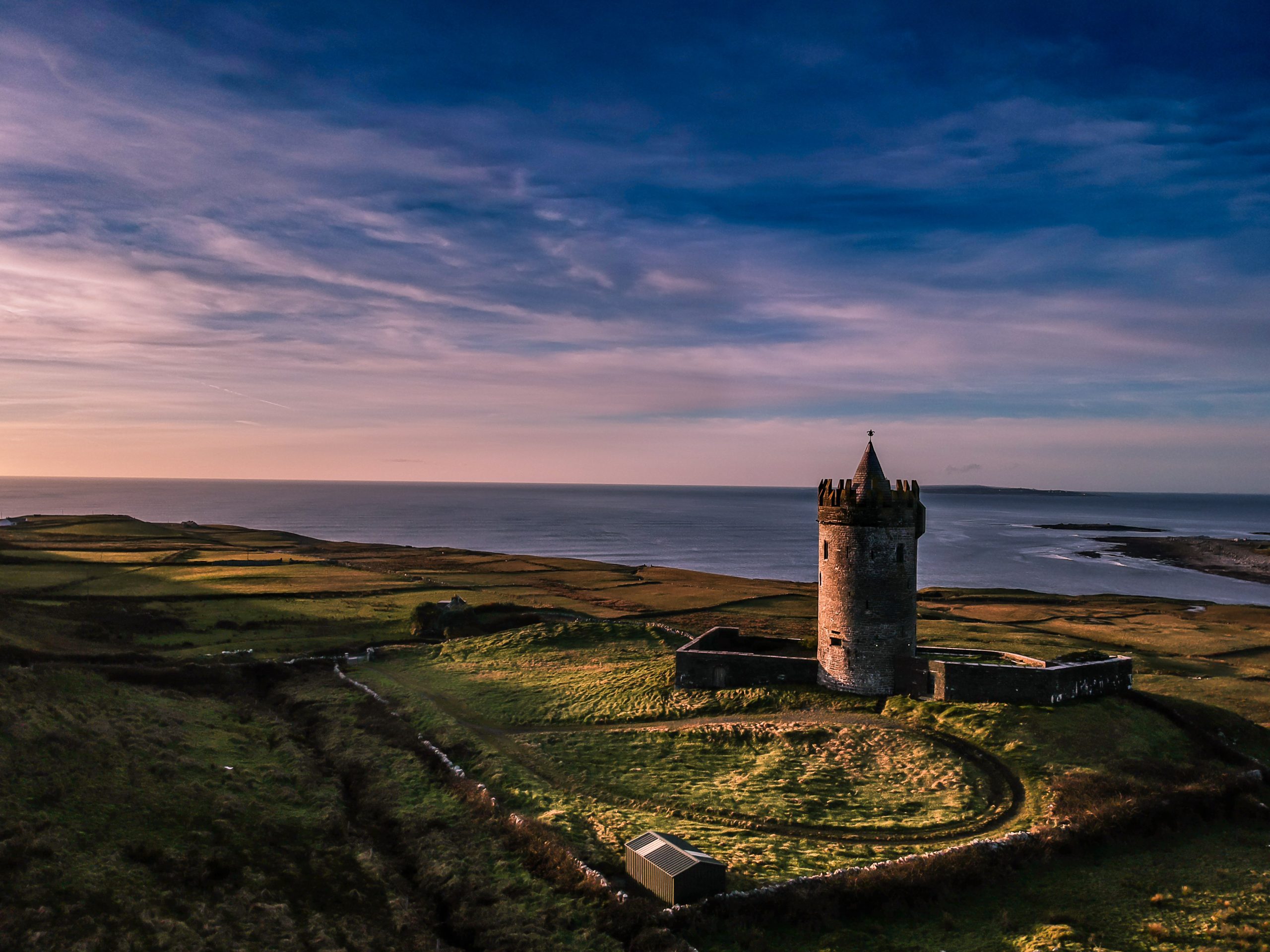
Doonagore Castle, a picturesque tower house situated in the proximity of the village of Doolin in County Clare, on Ireland’s west coast, overlooking the North Atlantic Ocean. Image source: Wikimedia Commons
This tower house stands on a relatively small hill, overlooking Doolin Point and the Atlantic Ocean. An important aspect about Doonagore Castle is the fact that is used alongside a nearby higher radio mast as a navigational point by boats which sail around and approach Doolin Pier. In more specific geographic regards, this interesting tower house is located in the townland of Doonagore, parish of Killilagh, County Clare (alternatively, sometimes it is considered to be situated in the area known as the Burren) and approximately halfway between Doolin village and the Cliffs of Moher.
The history of this tower house
The site of this tower house was previously likely occupied by a castle and an even earlier ringfort respectively by Tadhg (Teigue) MacTurlough MacCon O’Connor for a certain period of time during the 14th century (or since the 1300s). The present-day tower house itself probably dates back to the mid-16th century. In stark contrast to other tower houses from this region of Ireland, this fortification was not constructed out of limestone but rather built from sandstone drawn from the quarry of Trá Leachain (Flaggy Beach) which is situated approximately 2 kilometres to the southwest.
During the late 16th century, namely in 1570, Doonagore Castle was the property of Sir Donald (or Donnell) O’Brien of the O’Brien dynasty. Later on, in 1582, it was occupied by Brian MacCahill O’Connor. Eventually, in 1583, most of the property was surrendered to the Crown and regranted to Turlough O’Brien of Ennistymon. Afterwards, it came into the possession of the MacClancy (or Clancy) family, the hereditary brehons or lawyers of the O’Briens.
In September 1588, one ship pertaining to the Spanish Armada crashed against the shore below the castle. 170 survivors of the respective shipwreck were caught by Boetius Clancy, the High Sheriff of Clare, and hanged at either Doonagore Castle itself or on a nearby Iron Age barrow around Doolin known Cnocán an Crochaire (or Hangman’s Hill). After the 1641 rebellion, Doonagore was granted to a certain John Sarsfield in the Cromwellian settlement. Throughout the late 17th or early 18th century, the castle became a property of the Gore family, hence being erroneously known as ‘Gore’s Castle’. The then new owners of the castle repaired it in the early 19th century, but by 1837 it had deteriorated. Eventually, many years later during the 1970s it was renovated by architect Percy Le Clerc for an Irish-American private purchaser by the name John C. Gorman. His family still owns this impressive and beautiful castle and navigational landmark.
Additional information
Doonagore Castle is one of the three cylindrical tower houses from the Burren region. The other ones are Newtown Castle and Faunarooska near Fanore. While it is true that it was mostly built out of sandstone, several decorative features of this tower house were carved from limestone. The original design of the tower house consisted of four floors and a cellar with a beehive vault between the first and second floors. The doorway of the fortification was protected by a machicolation connected to the wall walk. Externally, a defensive stone wall known as bawn surrounded the tower and a relatively small courtyard. Below you can watch a very beautiful aerial footage of Doonagore Castle and the Cliffs of Moher by YouTube user gavair1:
Documentation sources and external links:
- The Wiki page of this beautiful fortification on www.wikipedia.org (in English)
- Doonagore Castle: History, Parking + Viewpoints on www.theirishroadtrip.com (The Irish Road Trip)
- Castles of Ireland – Doonagore Castle on www.britainirelandcastles.com
- Doolin Ireland, the Traditional Music Capital of Ireland including Doonagore Castle on www.youtube.com
- An evening excursion to Doonagore Castle 🏰, County Clare, Ireland 🇮🇪 on www.youtube.com