

Bukkehorn – An Ancient Traditional Scandinavian Instrument
Bukkehorn is an ancient traditional Scandinavian musical instrument from Norway and Sweden. Alternatively, it is also known or referred to as either prillarhorn or trompethorn. In Swedish, it is known as bockhorn. The history or roots of this Scandinavian musical instrument dates back to the Stone Age, therefore it is quite ancient. The bukkehorn can be made from either a billy goat’s horn, a sheep’s horn, or a cow’s horn and has multiple finger holes in it as well as a hole in the pointed end (made with the purpose of blowing in it). The number of finger holes varies, but, typically, the most common variation ranges from 3 holes to 5 holes.
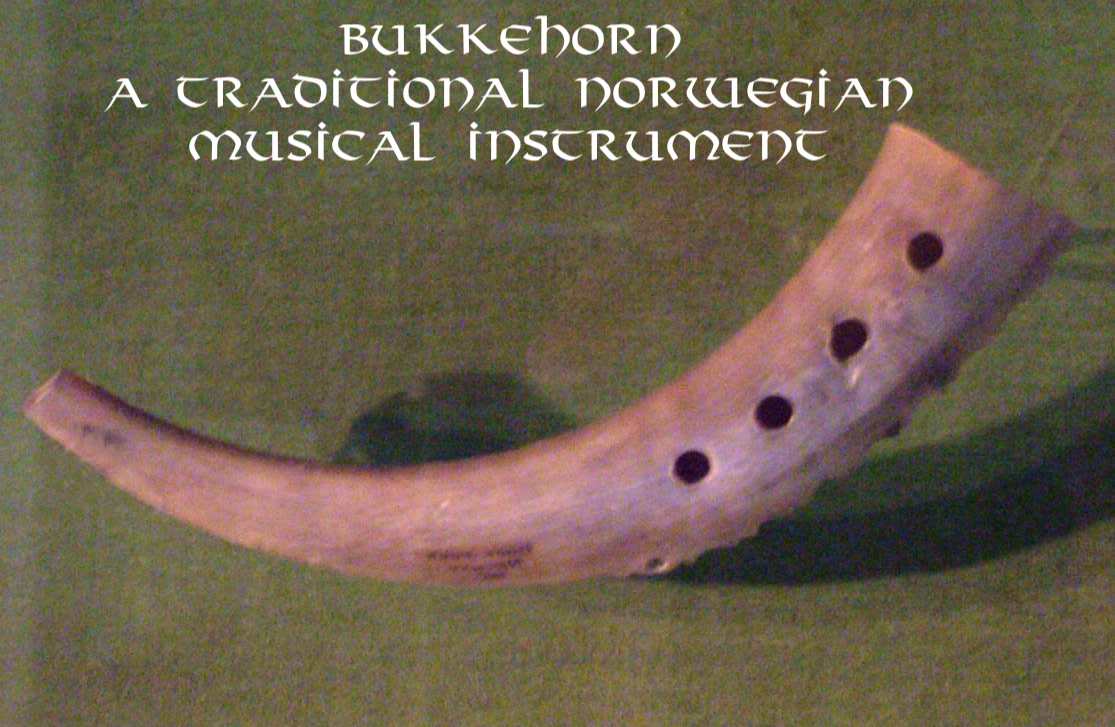
Photograph depicting a bukkehorn, on display at the Metropolitan Museum of Art in New York City, United States of America (USA). Image source: Wikimedia Commons (annotated using the Viking font as well)
The bukkehorn was used for thousands of years by farmers, herders, and shepherds to scare off wild animals (i.e. bears, wolves, or lynxes) that could threaten their livestock. In addition, throughout the passage of time, the bukkehorn was also used for signalling and ritual-based purposes. However, it was also used as a musical instrument for creating relatively simple melodies. The addition of finger holes to the rather rudimentary (but efficient) design of the musical instrument had likely occurred at a certain point in time by the beginning of the Bronze Age. The bukkehorn was used by shepherds and milkmaids (or budeia, budeie respectively budeier in Norwegian) on mountain farms (or seter respectively setra in Norwegian) in summertime during the Middle Ages to scare off wolves and signal cattle and has survived well into the 20th and 21st centuries. There are several types of bukkehorn, but the main variants are the trumpethorn (i.e. trumpet-blown horn) and the flishorn or tungehorn (i.e. reed horn) respectively.
Below you can listen to a bukkehorn musical sample embedded via the YouTube channel Vikingskog (i.e. Viking forest):
Documentation sources and external links:
- The page of this musical instrument on www.wikipedia.org (in English)
- The page of this musical instrument on www.wikipedia.org (in Norwegian Bokmål; an article within which I also contributed throughout the passage of time)
- The history of the bukkehorn on www.blasemaker.no (in English)
- A comprehensive article on the history of this Scandinavian musical instrument by Sissel Morken Gullord on www.hornsociety.org