
The Minoans And The Bronze Age Collapse
The island of Crete as well as the adjacent islands in the Sea of Crete and the Libyan Sea (more specifically in the region known as the South Cretan Sea) were home to a thriving and advanced civilisation during the Bronze Age, widely regarded as Europe’s first and eldest civilisation. This civilisation was named the ‘Minoans‘ by English archaeologist Sir Arthur Evans who collaborated with Scottish archaeologist Duncan Mackenzie (his assistant) during the process of excavation of the ancient Minoan palace of Knossos (an extensive archaeological process which unfolded between 1900 and 1931; though before Evans’ work the site of the palace was excavated as early as 1877 by the Cretan Greek amateur archaeologist and businessman Minos Kalokairinos and his team), the first palace built in Europe (Knossos is also considered the oldest city in Europe). They were named as such as a reference to the legendary King Minos of ancient Greek myth and fame. It is still not quite well known how the ancient Cretans referred to themselves, but what is known is the fact that the ancient Egyptians called them ‘Keftiu‘. According to relatively new genetic research, the ancient Minoans were considerably descended from Neolithic farmers from Anatolian who migrated westward to Crete in the past.
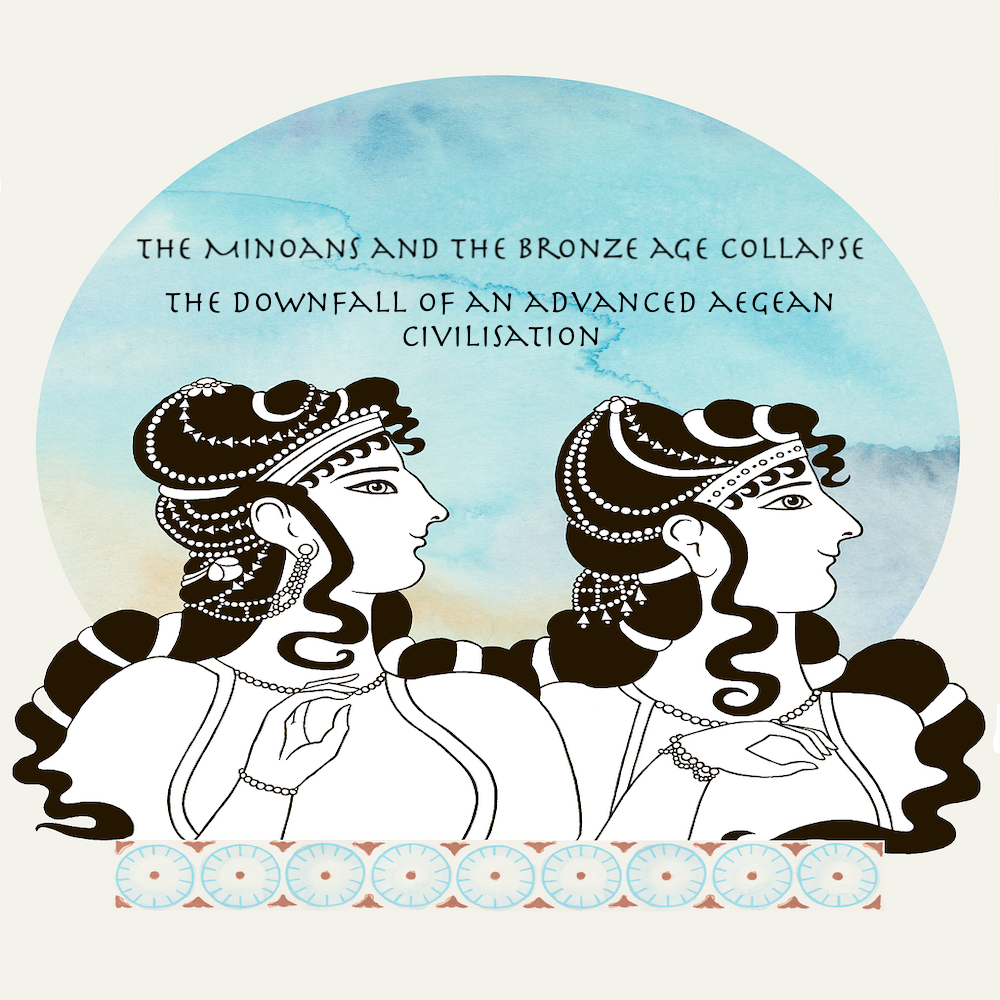
The Minoans and their subsequent demise was significantly linked to the Late Bronze Age Collapse of the ancient world. Annotated illustration with the Herculanum font. Original image source (inspired by the famous and beautiful Ladies in Blue fresco): www.pixabay,com
The ancient Cretans were a great seafaring people and civilisation whose trade networks reached far and wide throughout the ancient world, being masters of navigation over the waves of both the Aegean Sea and the Mediterranean Sea. They were significantly influenced by the ancient Egyptians, as it can be clearly observed in their colourful, vibrant, and fascinating art, most notably in their beautifully painted frescoes which depict marine life, animals, women as well as their way of life in their settlements (e.g. processions).
Nonetheless, as with all ancient empires and civilisations, their thalassocracy (i.e. maritime empire) which spanned far and wide, as eastward as Cyprus, as northward as the Greek mainland, or as westward as the south of present-day Italy, crumbled as of the cause of both natural disasters and a subsequent invasion of the Mycenaeans (i.e. the mainland proto-ancient Greeks). The eruption of the volcano on the island of Santorini (or Thera/Thira) in circa 1500 BC/BCE (one of the biggest and most shattering of its kind in the history of mankind), nowadays a very beautiful and popular tourist attraction, situated approximately 70 miles north of Crete unleashed massive tsunami waves, earthquakes, and ash clouds over the Minoan civilisation, obliterating the Minoan colony on the Cycladic island initially in the process. The palatial system of the ancient Minoans on Crete was severely damaged in the wake of these natural disasters and, it is believed by some, the then weakened state of the Minoans (who, although managed to rebuild their damaged palaces) made them an easy prey for the invading Mycenaeans who eventually took control over the island of Crete. For a period of time however, the Minoan culture (which influenced that of the Mycenaeans) co-existed with that of the new conquerors stemming from the Greek mainland. Furthermore, the relative sudden downfall of the ancient Minoans is thought by some to represent the inspiration behind the myth or legend of Atlantis, as recounted by Plato in two of his dialogues entitled Timaeus and Critias. Last but not least, the eruption of the volcano on Thera (which left a massive caldera behind it) was part of the Bronze Age collapse, as was the partial demise of the Minoan civilisation caused by it.
The documentary below (uploaded by the YouTube channel hazards and catastrophes) was made with the purpose of elucidating the mystery behind the downfall of the ancient Cretans. I truly hope you will find it interesting as I did. Thank you very much for your time, attention, and readership! All the best and please never stop asking questions and researching!
- The Minoan Thalassocracy: Dominance Of The Ancient Seas on www.knossos-palace.gr (in English)
- Minos Kalokairinos: The Original Excavator of Knossos on www.minoanmagissa.com
- Eruption of Thera on www.britannica.com (the online version of Encyclopædia Britannica)
- Late Bronze Age collapse on www.wikipedia.org (in English)
- The Eruption of Thera on www.forbes5pitt.edu (the website of the University of Pittsburgh)
- Europe’s first advanced civilisations originated from TURKEY: Early Greeks were descendants of early Neolithic farmers who migrated from Anatolia, DNA reveals on www.dailymail.co.uk