

Why Was Alfred The Great Recorded In History As The Great?
King Alfred the Great (born in circa 849 – deceased on 26 October 899; reigned between 871 to 886 as King of Wessex and then between 886 until his death in 899 as King of the Anglo-Saxons) is one of the most important royal personalities in English history. He earned his reputation as a great monarch through multiple dimensions of his reign which brought peace, prosperity, and a flourishing of the arts and culture in Anglo-Saxon England. Thus, he rightfully became the greatest of all Anglo-Saxon kings. In this brief article, I am exploring his significant role in Anglo-Saxon or early medieval English history as well as his important historical legacy in the context of the geopolitical development of early medieval England to the best of my capabilities.
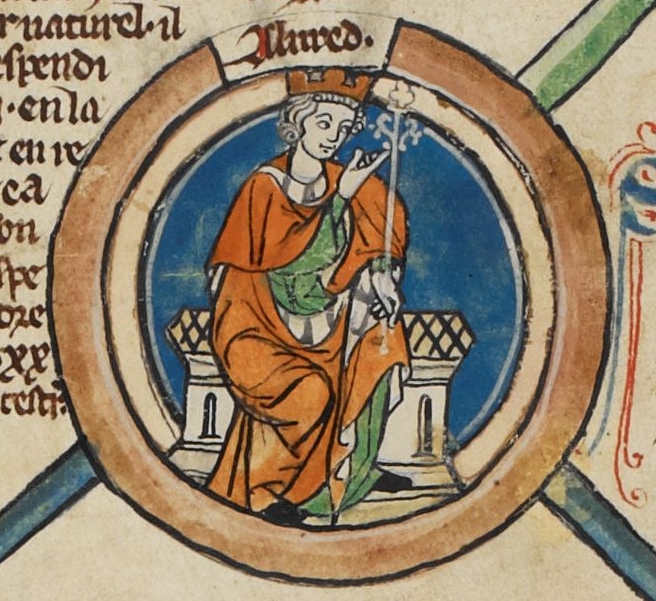
A 14th century late medieval miniature of King Alfred the Great of Wessex from a royal genealogy manuscript by an unknown author. Image source: Wikimedia Commons
The military dimension of his reign
King Alfred the Great was a skilled and brave military leader of the Anglo-Saxons who stood up against the invasion and oppression of the Danish Vikings, managing to preserve the independence of the (West) Saxon kingdom of Wessex against the Danes and the neighbouring Danelaw (i.e. the territory conquered by the Danish Vikings in the north-east and centre of Anglo-Saxon England where their laws held sway over those of the local Anglo-Saxons, formally after 878). Previously, the kingdoms of East Anglia, Northumbria, and Mercia (all Anglian kingdoms, i.e. populated by the Angles) were subdued by the Danes.
King Alfred ordered the construction of fortified towns known as burhs to be able to withstand any external military threat represented by the Danish Vikings and so that the Kingdom of Wessex wouldn’t share the same fate as the other aforementioned fallen Anglo-Saxon kingdoms. These forts were built at strategic locations. Furthermore, the army of the Kingdom of Wessex was reorganised under King Alfred’s rule and ships were also used in warfare against the incoming Danish Vikings. Eventually, he managed to bring a relative peace, first after the Battle of Wilton (871) for five years then conclusively after the Battle of Edington or Ethandun (which took place in May, 878 in Wiltshire; which he won against the Danish warlord Guthrum) under the Treaty of Wedmore. In the wake of these events, the Danish warlord Guthrum even converted to Christianity along with his men and became King of Mercia.
Through his actions on the battlefield, King Alfred the Great paved the way for the subsequent unification of Anglo-Saxon England. Nonetheless, it was much later under the reign of Alfred’s grandson, Æthelstan, that Anglo-Saxon England would be at long last fully united (although it can be said that the first king of a unified Anglo-Saxon England as ‘Bretwalda’, i.e. overlord or wide ruler over all the other Anglo-Saxon kingdoms collectively representing the Heptarchy, was in fact Egbert of Wessex in 829, thus much earlier, but solely in terms of hegemony). Consequently, Æthelstan went down in history as Rex Anglorum (i.e. King of the English).
The cultural dimension of his reign
King Alfred the Great was a monarch who went down in history as a promoter of culture and literacy as well. The famous Anglo-Saxon Chronicle was written down during his reign, more specifically in circa 890. It is quite likely that King Alfred admired Charlemagne, the Frankish emperor who revived education in his vast realm. He learned Latin himself and then became a translator of Latin books in Old English starting in 887. He also invited scholars from Wales, Mercia, and from mainland European to his court as part of his efforts to promote knowledge, wisdom, and culture. It is precisely this very important cultural dimension of his reign that, above all, rightfully earned his reputation as a great monarch (for it was through education that a strong kingdom would survive for many years to come). Last but not least, the arts and architecture also flourished under King Alfred’s reign, with foreign craftsmen contributing in both fields after they were invited to his realm. His life and deeds were carefully recorded by the Welsh scholar and monk Asser. Through the work of Welsh scholar Asser, King Alfred is portrayed as a compassionate and kind monarch.
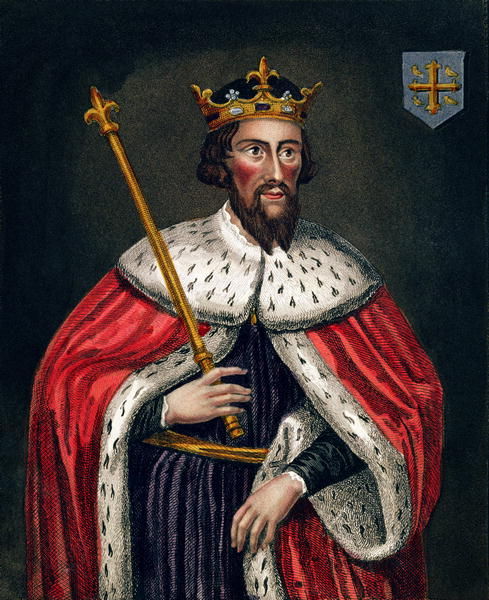
A portrait of King Alfred the Great of Wessex dating back to the 19th century. Image source: Wikimedia Commons
The diplomatic dimension of his reign
King Alfred the Great was equally a good diplomat, creating friendly relations with the neighbouring kingdoms of Wales to the west and Mercia to the north and east. These diplomatic relations were necessary for regional peace and stability as well as for military purposes. In addition, King Alfred was also a pious monarch which boosted his diplomatic skills and reputation.
The lawful dimension of his reign
King Alfred the Great was a fair monarch who established a rightful taxation system as well as a functioning justice system which protected the oppressed. Codes of laws were promulgated by him as well, strengthening the judiciary system.
Conclusions
King Alfred the Great’s reign was marked by military challenges which he managed to overcome and emerge victorious from, but, at the same time, his interest in culture, the arts, and religious life as well rightfully granted him the epithet ‘the Great’, the only native (or autochthonous) English monarch to have received this glorious reputation, based on his honourable life and deeds. Thank you very much for your time, attention, and readership! All the best!
P.S. Below you can watch a documentary embedded via YouTube by the channel Chronicle – Medieval History Documentaries on the life and reign of King Alfred the Great of Wessex.
- Alfred on www.britannica.com (the online version of Encyclopædia Britannica)
- Alfred the Great on www.wikipedia.org (in English)
- Athelstan on www.britannica.com (the online version of Encyclopædia Britannica)
- The Battle at Wilton (871 AD) on www.king-alfred.com
- Battle of Edington (878) on www.britannica.com (the online version of Encyclopædia Britannica)
- Anglo-Saxon Chronicle on www.britannica.com (the online version of Encyclopædia Britannica)
- The Heptarchy on www.britannica.com (the online version of Encyclopædia Britannica)
- The Anglo-Saxon Chronicle on www.tha-engliscan-gesithas.org.uk
- King Alfred’s Theory of Friendship, MA thesis by Ross Smythe (2001) on www.academia.edu
- Who was Alfred the Great? on www.bbc.co.uk
- Alfred ‘The Great’ (r. 871-899) on www.royal.uk
- Treaty of Wedmore on www.oxfordreference.com
- King Egbert on www.historic-uk.com
- Who was the first King of England? on www.heritagecalling.com
- The Kingfisher History Encyclopædia, pages 122–123 on Google Books