
A Brief History Of The Vikings In Scotland
The Norse, commonly known as the Vikings, had a significant presence on the territory of Scotland during the Early Middle Ages, as it was the case elsewhere throughout the landscapes of the British Isles (most notably in early medieval Ireland and England). The Norsemen had a notable and long-lasting impact and historical legacy in early medieval Scotland during the renowned Viking Age. Significant areas of Scotland were colonised by the Norse during this period of time, their influence being felt for several centuries. This particular period of time in Scottish history is known as Scandinavian Scotland and lasted from the 8th century to the 15th century. The Vikings who were mostly interested to settle in Scotland were the Norwegian Vikings. However, that is not to say that the Norse who found a new home on Scottish soil were solely Norwegians. Among these settlers were also other Scandinavians, but to a much lesser extent than the Norwegians. The geographical proximity between south-western Norway and northern Scotland facilitated settlement and trade between them during the Early Middle Ages. Norse raiding, trade, and settlement were conducted over the North Sea by using the longships, some of the most efficient, durable, and, at the same time, feared vessels of the Middle Ages.
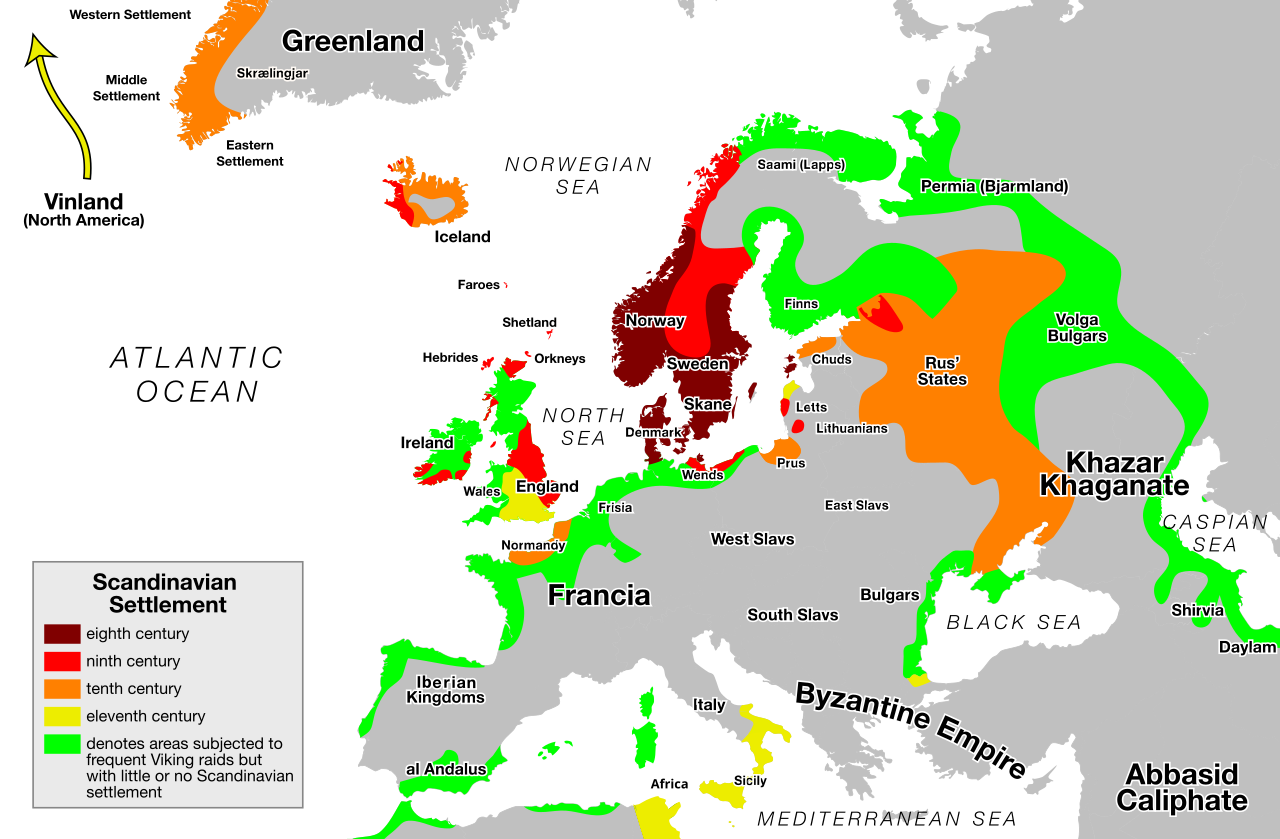
Map depicting the Norse settlement of various areas of mainland Europe and insular Northwestern Europe during the Early Middle Ages. Scotland was colonised primarily by Norwegian Vikings over the course of several centuries, but this map claims settlement can be traced back to the 9th century in some red-marked areas (although its chronological validity can be disputed and therefore might not be 100% accurate). Image source: Wikimedia Commons
The Norse presence in Scotland commenced in the late 8th century and increasingly continued during the upcoming centuries to the point where two important north-western European cultures, the Norse and the Gaels, co-existed and fused to form the Hiberno-Norse (or Norse-Gaels). Furthermore, geopolitically, the interactions between the Earls of Orkney and the Kingdom of the Isles recurrently involved the Kingdom of Norway later on. The areas were the Norse settled the most were the Northern Isles (i.e. Orkney and Shetland), the Hebrides, the islands of the Firth of Clyde as well as Caithness and Sutherland on the Scottish mainland (the two northernmost provinces of mainland Scotland). Of all these aforementioned territories, the Northern Isles (known in Old Norse as Norðreyjar) experienced the most significant and long-lasting Norse presence. In addition, the west of Scotland, from Wester Ross to Kintyre, was also subject to Norse colonisation throughout the passage of time. On the other hand, the Southern Isles (or Suðreyjar as they are alternatively known in Old Norse) also experienced an important degree of Norse colonisation. The Southern isles comprise the Inner and Outer Hebrides, the islands of the Firth of Clyde, and the Isle of Man.
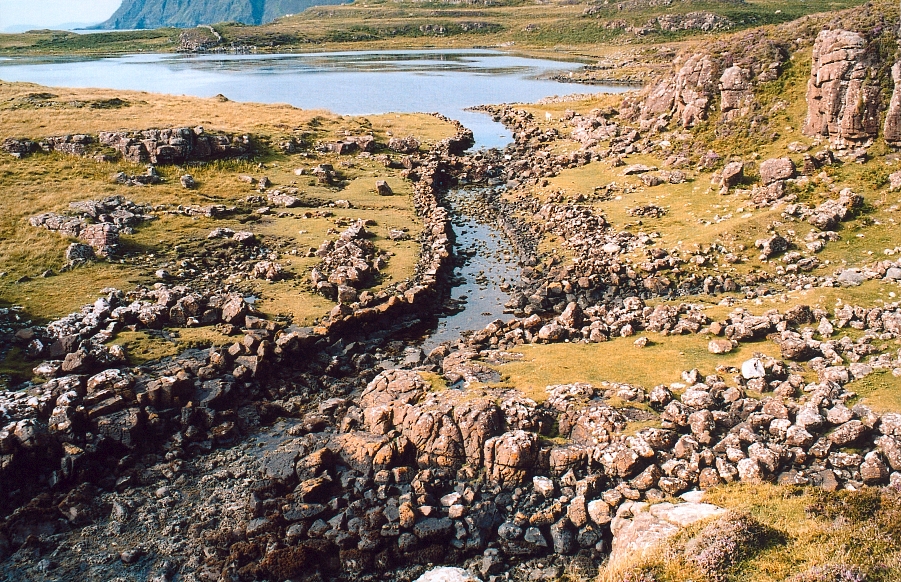
The so-called ‘Viking Canal’ in Loch na h-Airde, Rubha an Dùnain, an uninhabited peninsula situated southward of the Cuillin hills on the Isle of Skye. Image source: Wikimedia Commons
This period of time in Scotland’s history is relatively scarcely documented, mainly through the Irish annals and the Icelandic sagas, in particular the Orkneyinga saga (i.e. The History of the Earls of Orkney). Nevertheless, these sources are somewhat contradictory or conflicting, but new archaeological discoveries and research began to shed more light with respect to this part of the Norse (and Gaelic) world. The influence of the Norse extended past Scotland to the Isle of Man to the south and then to Ireland to the west respectively. To the south of Scotland, early medieval England (or Anglo-Saxon England) was frequently subject to raids and invasion by the Danish Vikings who had eventually established their own state on a significant part of its territory known as the Danelaw (where the laws of the Danes held sway over those of the local Anglo-Saxons). An important Viking Age site in the Shetland Islands is Jarlshof.
Documentation sources and external links:
- Scandinavian Scotland on www.wikipedia.org (in English)
- Scotland in the Early Middle Ages on www.wikipedia.org (in English)
- The Vikings in Scotland on www.vikingeskibsmuseet.dk (in English)
- The Vikings in Scotland: Dumbarton and beyond on www.blog.historicenvironment.scot
- A brief history of the Viking Age in Scotland on www.scottishbanner.com
- History of Vikings in Scotland on www.visitscotland.com
- Scottish Vikings on www.sonsofvikings.com
- Who Were the Vikings? on www.digitscotland.com
- Map of Viking Scotland on www.viking.no (in English)
- The Kingdom of the Isles: Viking Archaeology in Scotland on www.digitscotland.com
- Map of the Viking places on www.followthevikings.com
- The Northern Frontier: Tracing Viking History and Settlements in the British Isles and Scandinavia on www.journeybeyondhorizon.com