

Hygiene In The Viking Age: Were The Vikings Clean?
The topic or subject of hygiene of the Norsemen during the Viking Age has been at times a bit controversial, depending on the medieval sources that are to be analysed in this particular regard. Controversial in the sense that certain sources are a bit conflicting and portray the Norse at totally different levels of hygiene, earning them different reputations correspondingly. For example, in Anglo-Saxon England, the Norse were reputed for their cleanliness and for the fact that they bathed weekly (which naturally made them quite attractive for certain Anglo-Saxon women).
At some point in the 10th century, Iberian-Moorish (Andalusian) chronicler al-Tartushi (who stemmed from the Muslin kingdom of Al Andalus at that time) was also impressed with the hygiene of the Norse after a visit to Hedeby (now Haithabu), an important commercial town situated in the south of Jutland, Denmark (now in northern Germany). He also mentioned that both men and women used makeup which enhanced their beauty. On the other hand, it must be mentioned that he was not particularly fond of the music of the Norsemen, describing it in a rather negative manner. The Arab traveller Ahmad ibn Fadlan described the Rus in one of his voyages as ‘the filthiest of Allah’s creatures’. According to him, the Rus he encountered had a very poor hygiene.
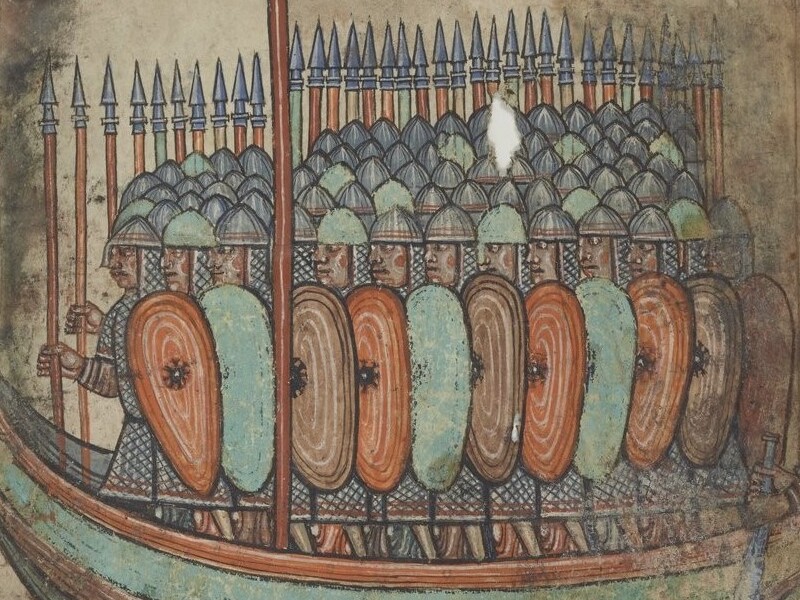
Medieval representation from the Abbey of Saint-Aubin dating to circa 1100 AD/CE depicting a group of Norsemen attacking the medieval town of
Guérande, Western France. Image source: Wikimedia Commons
As per the writings of 13th-century English chronicler John of Wallingford (namely from a chronicle dating back to 1220), the Norsemen were described as quite clean, having the habit of bathing each Saturday, their washing day (known as laugardagr in Old Norse, laug meaning either bath or bathing water). Another important source from medieval Britain on the hygiene of the Norsemen is represented by a 793 letter of the Anglo-Latin scholar Alcuin, an important intellectual of the Carolingian era, to King Æthelred of Northumbria (in which he also detailed the famous Viking raid which took place on the Holy Island of Lindisfarne) who warned the Anglo-Saxons to stop combing their hair, trimming their beards, and having a similar ‘fashion’ style or look as the Norse in, these aspects being perceived as sinful:
‘Consider the dress, the way of wearing the hair, the luxurious habits of the princes and people. Look at your trimming of beard and hair, in which you have wished to resemble the pagans. Are you not menaced by terror of them whose fashion you wished to follow?’ Source: www.digventures.com
The fact that the Norse typically bathed during Saturday is also mentioned in the Icelandic sagas. The washing day was not only served for personal hygiene but also for socialising and conducting business. In Iceland the hot springs were an ideal naturally-heated source of fresh water whereas in their native Scandinavia the Norsemen built their settlements in the proximity of rivers and lakes in order to obtain fresh water for cleaning.
The Norsemen also changed their clothes frequently. Grooming was also a common practice for the Norsemen. Taking these sources in consideration, the Norsemen were actually very clean for their time. The Early Middle Ages (as well as the Middle Ages in general) was a historical period of time during which hygiene was either perceived with suspicion or not that existent. That’s why, later on, stricter rules had to be applied for public hygiene in medieval European towns (previously the waste was thrown out of the window in public).
The hygiene of the Norse during the famous Viking Age (a tumultuous period of time which was part of the broader Early Middle Ages) can be proved by a series of archaeological finds such as combs made of bone or wood, a washing bowl found in Kaupang, Norway or some sort of ear scoops respectively tweezers discovered at Birka in Sweden, another important commercial town in Viking Age Scandinavia. The Hávamál, a long Old Norse poem attributed to the god Odin, there are several lines which put an emphasis on cleanliness and the positive reputation it can bring when travelling. The Reginsmál also puts an emphasis on personal hygiene. Overall, it is safe to conclude that the Norsemen were some of the cleanest populations during the Early Middle Ages. Thank you very much for your time, attention, and readership! All the best!
Documentation sources and external links:
- New Discovery Suggests the Arabs Met the Vikings in Ancient Times, an article by Mihai Andrei on www.zmescience.com
- Hygiene in the Viking Age on www.museumnord.no
- Viking Hygiene, Clothing, & Jewelry on www.worldhistory.org
- The Barber Surgeon on www.vikingeskibsmuseet.dk (the official website of the Viking Ship Museum in Roskilde, Denmark)
- Norse and Viking Hygiene on www.thewarriorlodge.com
- Filthy Barbarians or Dapper Danes? on www.sonsofvikings.com
- The Honor and Hygiene of Vikings on www.norsevikingsoap.com
- Viking Hygiene: The Evidence of Better Habits on www.asgardalaska.org
- Trade took the Vikings to a new era on www.norsevikingsoap.com
- Hedeby on www.vikings-and-valhalla.com
- Alcuin on www.wikipedia.org (in English)